What Summer Did to Your Garage Floor And Why Fall Is When You Fix It
Most homeowners think fall is the right time to schedule a coating because summer is over. That is true, but it misses the more important question: what did summer do to your slab? A Texas garage floor that spent four months absorbing 100-degree heat, oil drips, and tire compounds is not automatically ready for coating just because the calendar turned to October. Before any coating goes down, the concrete itself needs to be evaluated.
If you have been searching for epoxy garage floor coating in Parker County TX that holds up through years of temperature swings and daily use, start here: the floor's condition in October is a direct product of what it endured in July and August. That evaluation is not a formality. It determines whether you get a floor that lasts a decade or one that starts peeling before spring.
A Texas Summer Leaves Damage That Does Not Announce Itself
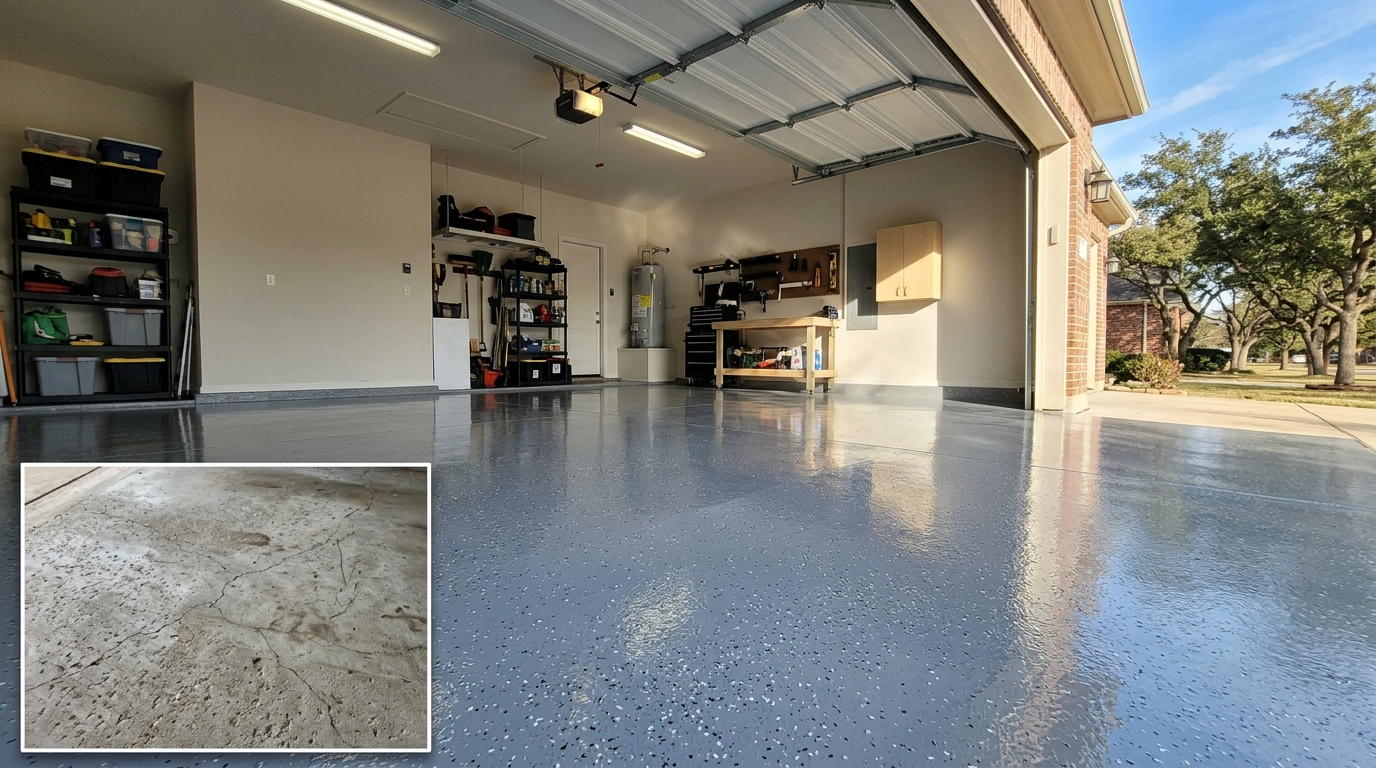
Concrete expands in heat and contracts when temperatures drop. A slab that sat under a metal garage roof through a Parker County summer absorbed that thermal cycle repeatedly. By fall, hairline cracks that did not exist in April show up at control joints, along the perimeter, and sometimes across the field of the slab itself.
Many of these are surface-level stress fractures, not structural failures. But a coating applied over an unrepaired crack will telegraph that crack through the epoxy within months. The crack moves. The coating does not. The bond fails at that seam first, then spreads.
We regularly see slabs come through summer with cracks that are clearly fresh. You can tell by the color: new concrete fractures are pale and clean-edged, while older ones are discolored from moisture and dust. Fresh cracking tells us the slab is still stabilizing thermally. Repair timing matters before we prime and coat.
Summer also leaves contamination you cannot see. Hot tire pickup deposits a rubber compound residue on concrete that is nearly invisible to the naked eye. Oil drips oxidize and bond into the surface pores. Even household cleaners used to hose down a garage floor can leave a residue that blocks adhesion.
Epoxy does not peel because it is a bad product. It peels because something sits between the coating and the concrete. That contamination cannot be removed with a pressure washer or a degreaser alone. Mechanical diamond grinding is the only method that physically removes contaminated material and exposes clean, porous concrete that epoxy can bond to at a structural level. No grinding means no real adhesion, regardless of product quality.
Moisture Shifts in Fall in a Way Most Installers Never Mention
During peak summer heat, concrete in Parker County tends to dry from the top down. Slab moisture moves toward the surface, evaporates fast, and readings look low. When temperatures cool in October and November, that dynamic shifts. Moisture migrates differently through the slab, and a floor that tested dry in August sometimes shows elevated vapor emission by fall.
This is not a reason to delay. It is a reason to test before you coat.
Elevated moisture trapped under an epoxy barrier has nowhere to go. It creates hydrostatic pressure that lifts the coating from below, and that failure mode is irreversible without grinding back to bare concrete and starting over. A qualified installer tests for moisture before any material touches the floor. That result drives primer selection and determines whether a moisture-mitigating barrier is needed before the base coat goes down.
Fall Temperatures Help, But Only After the Prep Is Done
Mild temperatures between 50 and 80 degrees are genuinely better for epoxy installation than the 95-degree heat of July. Epoxy chemistry performs more predictably in that range. Pot life is longer, application windows are more forgiving, and the curing process is more controlled. Fall in Parker County and the broader Fort Worth area delivers those conditions consistently from late October through November.
Favorable temperatures do not fix a contaminated slab or seal a fresh crack. The seasonal window matters, but getting the prep right is what makes the window worth using.
At NES Flooring, the same crew that walks your floor at the consultation handles the grind and the coat. No subcontractors, no handoffs. When we find something at the evaluation stage, the person who found it is also the person doing the repair. That continuity matters more than most homeowners realize until they have dealt with a job where the estimator never shows up again after the deposit clears.
Questions Homeowners Ask Before Booking a Fall Installation
My floor looks fine. Does it really need to be evaluated before coating?
Yes, and the reason is not about appearance. Surface contamination, micro-cracking, and moisture conditions are not visible from the doorway. The evaluation tells us whether the slab is ready or needs a repair step first. A floor that looks clean can still carry rubber residue or oxidized oil deep in the pores that will block adhesion and cause the coating to fail.
I tried to coat it myself two years ago and it peeled. Can fall prep fix that?
The failed coating has to come off completely before anything new goes down. Grinding removes it and resets the surface to bare concrete. A failed DIY install is not a reason to write off the project. It is one of the most common starting points we see, and the slab underneath is usually fine.
How long does fall installation take, and when can I park in the garage again?
Most residential jobs complete in one day. You can walk on the floor within 12 hours of the final coat and drive on it at 72 hours. Fall temperatures in Parker County keep that cure schedule reliable, without the accelerated complications that summer heat creates.
What if I get a quote somewhere else for half the price?
That price gap almost always lives in the prep. A crew that skips diamond grinding and goes straight to coating can move fast and charge less. The floor will also start failing within a year, sometimes sooner. The question to ask any installer is not what the coating costs. It is how they open the concrete before anything goes down. If grinding is not in the answer, the price does not matter.
Book Your Fall Evaluation Before the Window Closes
Fall books faster than homeowners expect. The window between October and mid-November is short, and contractors who do quality prep work fill it quickly. If you are in Weatherford, Aledo, Springtown, Granbury, or anywhere else in Parker County and you have been waiting to pull the trigger on your garage floor, now is the time to find out what your slab actually needs.
Call NES Flooring at 817-668-5051 or request your complimentary consultation online. We walk your floor, evaluate the concrete condition, identify cracks and contamination, test for moisture, and give you a detailed quote with no surprises. Every installation is backed by a 10-year workmanship warranty because we do the prep that makes that guarantee possible.
Do not spend another winter parking on bare concrete that has been sitting on your to-do list since spring.
Ready to work with NES Flooring?
Let's connect! We’re here to help.
Send us a message and we’ll be in touch.
Or give us a call today at 817-668-5051
More from NES Flooring: